A way of eating, not a dish
The word comes from the Persian mazze, roughly meaning « to taste ». It travelled across the old Ottoman world before coming to describe, in Lebanon, what is placed at the centre of the table: a series of small dishes that belong to nobody and that everybody reaches into.
That is where it parts company with a European starter. A starter comes before the main course. Mezze comes before nothing: it is the meal, or at least the greater part of it. Dishes arrive as they are ready, you go back to them, you mix them, and it carries on for as long as the conversation does.
Cold first, hot after
Cold mezze opens the meal. Hummus, chickpea purée whipped with sesame cream and lemon. Mutabbal, its grilled aubergine counterpart, which keeps the taste of the embers. Tabbouleh, which in Lebanon is first and foremost a parsley salad: the cracked wheat is there to bind, unlike the French version where semolina dominates. Vine leaves stuffed with rice, rolled by hand, served cold and sharp with lemon.
Hot mezze follows, and it changes the pace. Kibbeh, a cracked wheat shell filled with meat, considered Lebanon's national dish. Falafel, a chickpea and broad bean fritter scented with coriander. Spinach fatayer, sambousek, cheese rikakat — all pastries, all cooked to order.
How many to order
The question comes up at every table, and the answer is simpler than it looks: count three to four mezze per person if they are your meal, two if a grill follows. Beyond six or seven guests you stop counting per head and simply build a broad spread, keeping a balance between the creamy, the sharp and the fried.
The classic mistake is to order only cold mezze, because those are the familiar ones. The meal then flattens out: everything is mild, everything is the same temperature. Two or three hot dishes are enough to bring it back to life.
Bread is not a side
Lebanese bread, flat and supple, is not set beside the plate: it is the utensil. You tear a piece, fold it between thumb and two fingers, and use it to scoop the hummus or the mutabbal. Nothing in a mezze spread is eaten with a fork, except the tabbouleh.
That also explains why a Lebanese meal is rarely a quiet one. Eating with your hands slows you down, makes you look up, leaves room to talk. The table is built for that.
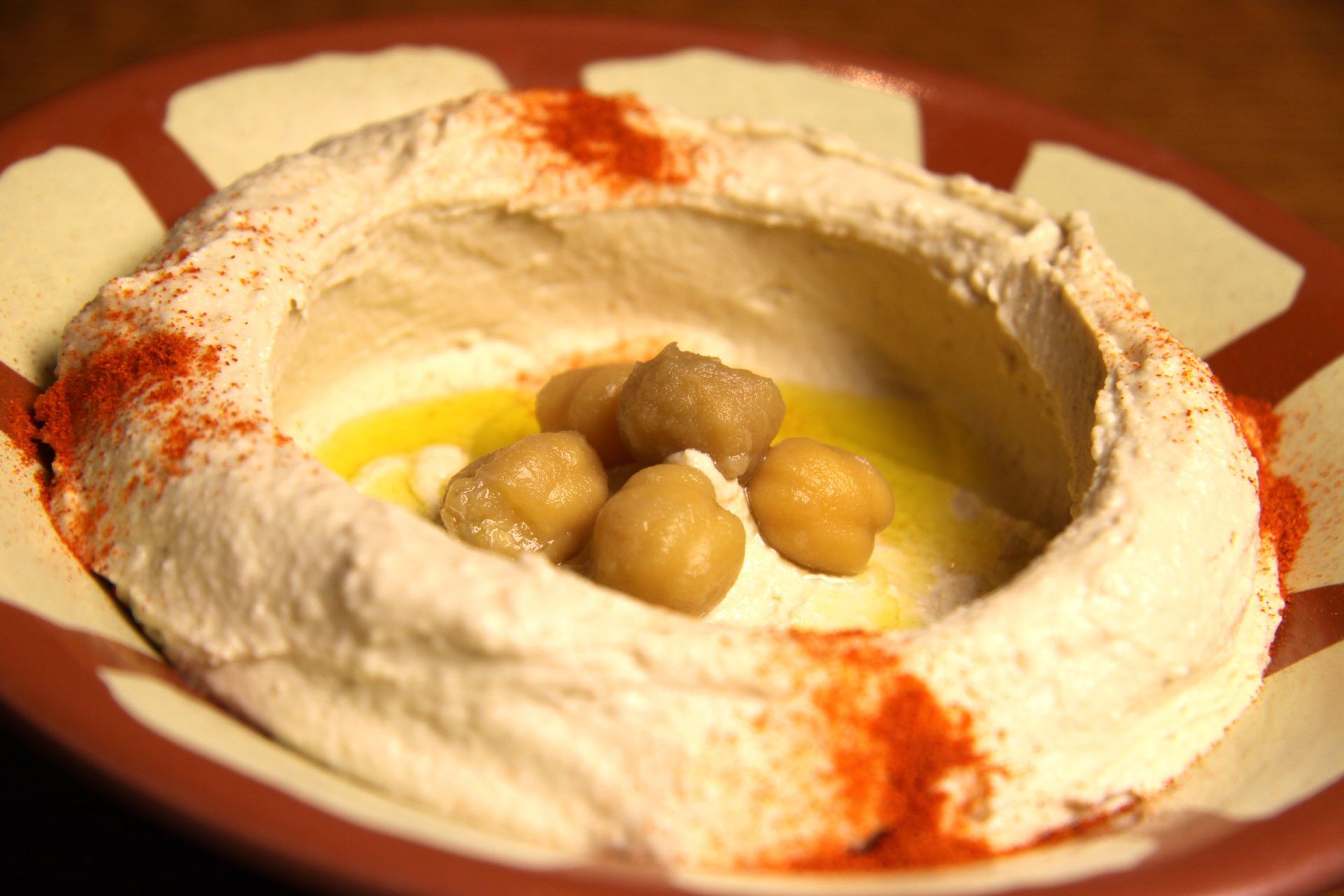
Hummus, chickpea purée with sesame cream and lemon